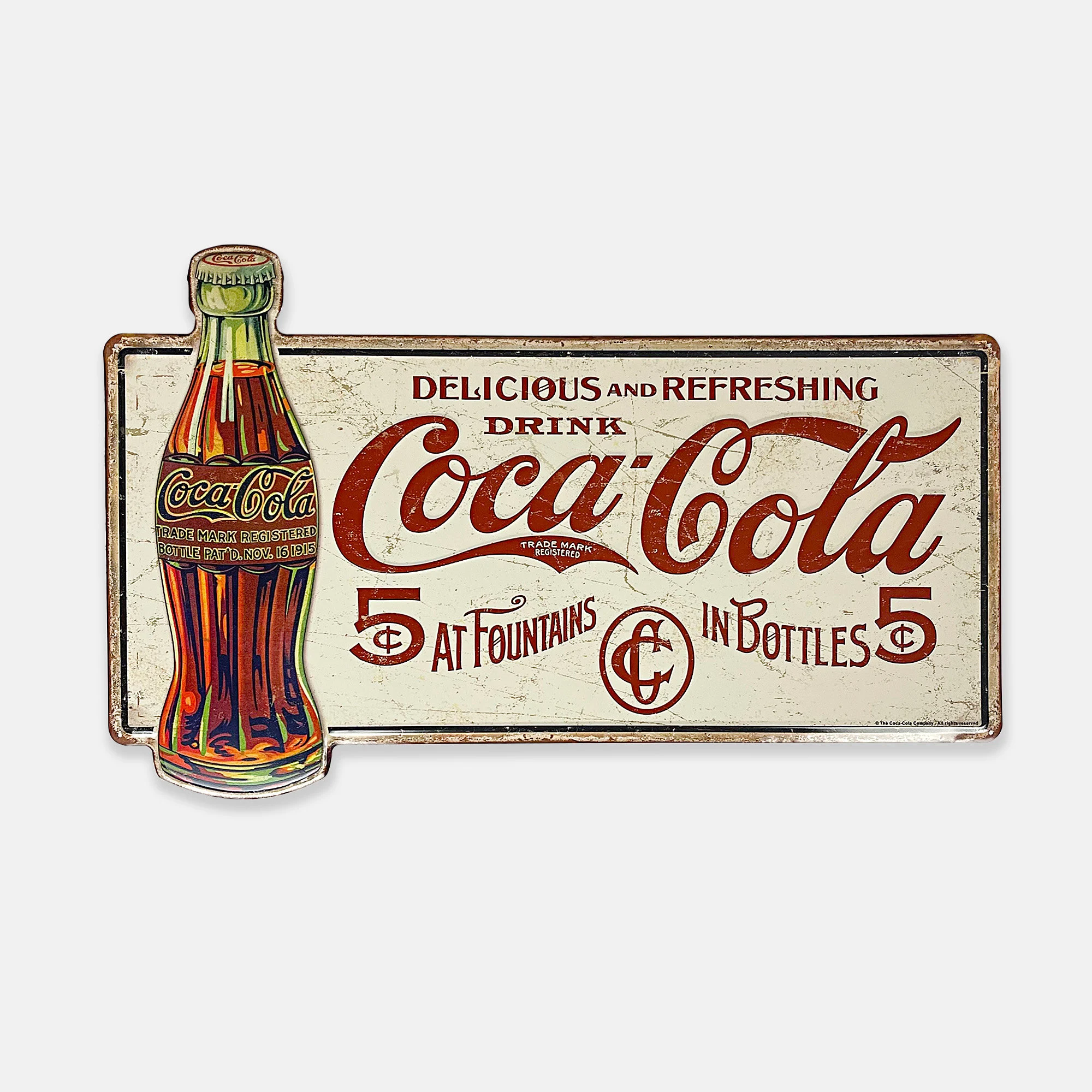
Coca-Cola Advertised Itself Into a Corner for Seventy Years
By Chinmay N Bharadwaj
A bottle of Coca-Cola cost five cents in 1886. It still cost five cents in 1959.
In between: two world wars, the Great Depression, Prohibition, sugar rationing, hundreds of new competitors including Pepsi, and a stack of lawsuits. The price of coffee, sugar, butter and milk all moved. Coke did not.
Economists have a name for this. They call it nominal price rigidity, and Daniel Levy and Andrew Young wrote a whole paper about it because seventy years is not stickiness, it is something closer to paralysis.
I went looking for how a company gets stuck like that. The answer turned out to be more interesting than a bad contract.
It started with a man trying to end a meeting
In July 1899, two lawyers from Chattanooga came to see Asa Candler, then president of Coca-Cola. They wanted the right to sell Coke in bottles. Candler thought bottles were a waste of time. Coke was a fountain drink, mixed fresh, that was the whole point.
So he signed the rights over for one dollar. The paperwork fixed the price he would charge them for syrup, with no expiry date. Legend says he never even collected the dollar.
You can picture the moment. A man signing a piece of paper to get two people out of his office.
Then the marketing made it permanent
Here is the part that stayed with me.
Coca-Cola could not legally put a price on the bottle and force retailers to honour it. So it did the next best thing. It advertised the price. Five cents, painted on the sides of buildings, printed in magazines, plastered across billboards, for decades, everywhere in America.
It worked exactly as intended. Consumers learned the number so completely that a retailer charging six cents looked like a cheat rather than a business.
And then it kept working, long after Coke wanted it to stop.
By the late 1940s costs were rising and the company genuinely needed to charge more. It could not. Not because of the contract, which had been renegotiated in 1921, but because it had spent fifty years teaching an entire country that Coca-Cola costs a nickel.
What they tried instead of raising the price
By 1950, Coca-Cola owned an estimated 85 percent of the vending machines in America, and almost all of them took one coin. A nickel. The next coin up was a dime, which meant doubling the price overnight.
One idea floated internally was to load one empty bottle into every nine, so the machine would occasionally take your nickel and give you nothing. Effectively a price rise, hidden as bad luck.
Another was stranger. In 1953, Coke president Robert Woodruff wrote to his friend Dwight Eisenhower and asked whether the Treasury might mint a seven and a half cent coin. Eisenhower passed it along. Treasury was not interested.
Read that again. A company found it easier to imagine changing American currency than changing its own price.
What I keep thinking about
I study marketing analysis at DePaul, and most of what we look at is how brands build things. Awareness, recall, association, loyalty. All of it framed as an asset.
The nickel story is the same process running in reverse. Every single thing Coca-Cola built became a wall. The advertising built a price expectation. The vending machines locked it in physically. The habit of handing over one coin locked it in culturally. Nothing here was a mistake. It was a strategy that succeeded so thoroughly it stopped being reversible.
That is the part nobody tells you about brand building. You are not just creating recognition. You are creating expectations, and expectations do not have an off switch.
You can see smaller versions of this everywhere now. Streaming services that trained a generation on nine dollars a month and now fight a churn war over every increase. Retailers whose sale price quietly became their real price, so the full price reads as a lie. Free shipping, which was a differentiator for about ten minutes and is now a baseline that costs money to maintain.
None of those brands made a bad decision. They made a good one, repeated it until it set, and discovered they had built a floor they now have to stand on.
The takeaway
Marketing does not only tell people what your brand is. It tells them what to expect from it.
Positioning can be changed. A logo can be redrawn. An expectation you spent decades teaching is a much harder thing to take back.
Coca-Cola needed the invention of a new coin to escape its own advertising. It never got one. It just waited until 1959.
Sources
- Daniel Levy and Andrew T. Young, "The Real Thing: Nominal Price Rigidity of the Nickel Coke, 1886 to 1959," Journal of Money, Credit and Banking, 2004
- NPR Planet Money, "Why Coke Cost A Nickel For 70 Years"
- Coca-Cola Bottling Co. v. Coca-Cola Co., D. Del., on the 1899 contract and 1921 consent decrees
- Stack's Bowers and the American Numismatic Association, on the 7.5 cent coin proposal